Once when my stepdaughter was in fifth grade her teacher
assigned her a page of fractions to be converted to decimals using long
division. This touched off one of the most memorable kitchen table homework
battles. She insisted that her teacher said she couldn’t use a calculator. I
shamelessly bribed her with one M&M for each problem completed. The
assignment was finished and turned in. I vowed I would never give a similar
assignment. My stepdaughter hated math, still hates math, and is choosing a
college/career path where she will no longer take math classes. (Probably not
because of this one assignment, but it didn’t help.)
When I teach conversion from fractions to decimals, I want my
students to see the pattern. I show them how to enter the fraction as a
division problem. They fill out a similar sheet to the one my stepdaughter was
given using a calculator. We discuss what they see for a particular fraction.
For example: 1/5 = 0.2, 2/5 = 0.4, 3/5 = 0.6 and so on. By having a clear
lesson focus, seeing the patterns, I can determine when my students should use
calculators and when they should not.
In every fourth grade classroom, I have a group who struggles
to become fluent in multiplication and division facts. This gets compounded
when I want them to multiply and divide large numbers. For some, I teach the
process and let them use multiplication tables for the facts they haven’t
memorized. Others have such a lack of number sense, that they don’t see the
following pattern: 8 X 4 = 32, 80 X 4 = 320, 80 X 40 = 3200.
I showed one student this process with a calculator. What
didn’t make sense for her when she saw someone else’s completed table, made more
sense when she used the calculator and wrote down the answers. I want to
emphasize the guided aspect of this process: she was making the calculations
and writing the answers. She could begin to predict how large the products
would be based on the number of zeroes in the factors, because she was doing the
work with a calculator as a tool. I wanted her to notice those patterns by
looking at accurate answers.
This year my whole class struggled with measurement. I
developed several lessons and stations for practicing length, volume, and
weight. One of the activities involved reading food labels and computing the
volume and weight of the contents. Because my focus was on learning the
relative amounts of these measurements, I let them use calculators for the
computations. I knew they were not strong enough to multiply decimals and
fractions without a tool.
When teaching students process and strategies for computing
numbers, I don’t let them use calculators. I am clear with my students, their
parents, and myself, when I am testing them on computation and when I want them
to go beyond and study patterns and develop more complex problem-solving
strategies. After all isn’t that when we use calculators as adults?
What do you think? How do you use calculators in your classroom?
Monday, August 18, 2014
Sunday, August 17, 2014
Quote of the Week -- August 17, 2014
“Start
by doing what’s necessary, then what’s possible, and suddenly you are doing the
impossible.” –St. Francis of Assisi
Have a great week,
Friday, August 15, 2014
Box and T-Chart
Most people know about Venn Diagrams when teaching compare and contrast. Someone showed me the box and t-chart form for displaying the same information. I find it is easier for students to write neatly inside the spaces. I also find it easier for students to create their own on notebook paper -- especially if you are facing a copy paper budget crisis for the fifth year in a row.
To download this form from my Google Drive, click here. Students write what the two topics have in common in the box and list the differences in the t-chart at the bottom. I often require a certain number of facts listed in each space.
Also, this weekend August 15-18 I am giving away a copy of School Poems for Poetry Notebooks from my Teachers Notebook Store.

Wednesday, August 13, 2014
Lincoln's Grave Robbers by Steve Sheinkin
I discovered this author this summer and I am in the process of reading everything in print he has written. I am not a history book fan, but he chooses incidents that are not well-known and shares these accounts in such an engaging way that they were more entertaining than some of the fictional stories I read this summer.
I had never heard about the plot to steal Abraham Lincoln's body and hold it for ransom. I don't want to give away too much, but it involves counterfeiters and the Secret Service. I plan to share this as a whole class read aloud, because it is such a well-written informational text.
Here is a police report form students can use to launch a related writing assignment.
To see more about my rating scale click here.
Connect with me on Goodreads.
Monday, August 11, 2014
Student Created Fraction Strips Part 2: sixths, eighths, and twelfths
If you missed the first part of Student Created Fraction Strips, click here.
Depending on the experience level of the students, I may introduce sixths, eighths and twelfths on the second day. If I have already taught the Magnified Inch lesson, some of the fractions may go more quickly.
I don't try to have students fold the sixths. We talk about the whole as 12 inches and dividing that equally in six pieces is the same thing as 12 ÷
I have students fold the eighths instead of measure. Each piece will be 1 1/2 inches and that is a little beyond what my students were capable of doing. Instead we fold half, then half of each half, and then half of each fourth.
Holding up a finished copy and showing the relationship between halves, fourths and eighths helps. As a final step, label the fraction strips you made today with the words and numbers for each fractions.
Sunday, August 10, 2014
Quote of the Week -- August 10, 2014
“The responsibility of leadership is not to come up
with all the ideas but to create an environment in which great ideas can
happen.”
Simon
Sinek
Have a great week,
Friday, August 8, 2014
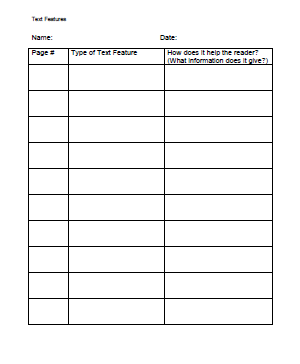
Text Features Form
If your class is like mine, you will spend some time teaching text features this year. I wanted to share a simple form that I use to see how my students are doing recognizing text features and explaining how they add to the text. Click here to download Text Features Recording Form from my Google Drive.
This chart is the basis for an anchor chart I develop at the beginning of the year. I have students work in pairs to find and record features and the next day independently. I have a class set of Eyewitness Books on different topics I use for this. I also use our textbooks and trade books for different units of study.
This year, we will have a subscription to Time For Kids. I know my students will have even more practice with text features.

Subscribe to:
Posts (Atom)